
The pressure of ‘the following day’ – our take on implementing strategy with SMBs
The pressure of ‘the following day’ – our take on implementing strategy with SMBs
Whether it’s the day following:
- an amazing workshop or speaker presentation,
- the Monday after a trusted team member or partner has built an incredible strategic roadmap or plan following blue-sky thinking and team collaboration
- the afternoon after you’ve met with your accountant and realized you need to make some changes to improve above the line / below the line on your P&L
you likely know the feeling as a business owner or leader. You’ve been motivated into applying changes in your business, but you’re strapped for time / people / resources, and your inbox has about 38 unread items + you have a video call in 12 minutes. So…you park the strategy or changes until you have more margin.
(no judgement….I’m a business owner and have sat in leadership in small and large organizations – I’ve done all of the above).
Suddenly it’s 6-weeks later and the idea or document is out of sight, and day-to-day business activities (and momentum!) hasn’t changed. I also lived this as a business advisor because it would break my heart to see strategies and plans that failed to launch.
It’s still Strategy First…. so don’t skip it.
Confession – I am biased when it comes to a strategy-first approach, but I’m also practical from years of working with and owning small to mid-sized businesses (SMBs – or if you’re in Australia, Small to Medium Enterprises (SMEs)).
Regardless of how much budget & time you have to create a strategy, I’m always going to encourage business leaders to lock this down first. Honestly, a white-board session where you’re defining direction for small businesses is equally as important as the multi-day strategic retreats with lots of team members because the landing spot is a summary of your longer-term plans to hit a set of goals and/or win in a competitive environment.
My thinking about building a strategy has morphed over time, and as a visual-learner I have historically valued McKinsey’s Three Horizon’s model (and have used it successfully in the past, with large and small organizations). It sets up a brilliant strategic framework to consider the short, medium, and long term business activities that all contribute to making those bigger long term goals happen. On a practical note, it also helps business leaders to pause and not jump on the latest fad or ‘shiny thing’ – it’s a great model for keeping focus. Source: https://www.mckinsey.com/capabilities/strategy-and-corporate-finance/our-insights/enduring-ideas-the-three-horizons-of-growth#/
Evolved strategy…especially for SMBs
Another confession – I’m a Steve Blank fan – anyone who reminds businesses to ‘get out of the building’ (i.e. go and talk to your prospects & customers…in person, virtually, it doesn’t matter but actually hear from them!) is worth listening to, as it’s one of the most important things any business size can do.
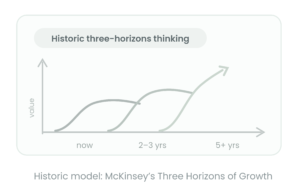 In a 2019 Harvard Business Review piece, Blank argued that the horizons are no longer bound by time: Horizon 3 disruption can now be delivered as fast as Horizon 1 work. (I can attest to this…we’re an AI company – we’re living this right now, and we work with many businesses who are navigating all sorts of modified changes and goals because of workplace efficiency, digital transformation, and the changing nature of our workforce today). (Source: https://steveblank.com/2019/01/08/the-fatal-flaw-of-the-three-horizons-model/ & https://hbr.org/2019/02/mckinseys-three-horizons-model-defined-innovation-for-years-heres-why-it-no-longer-applies )
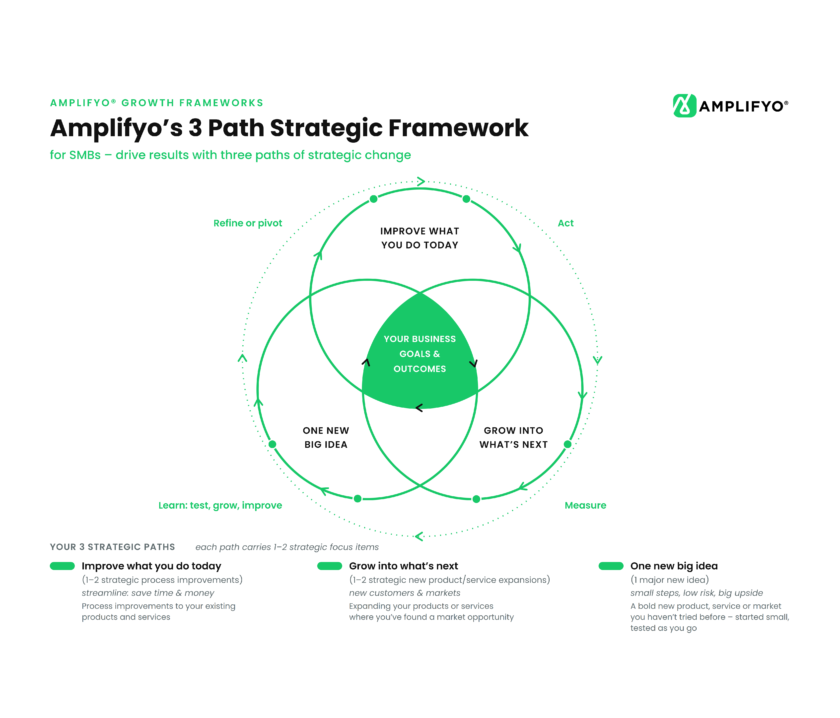
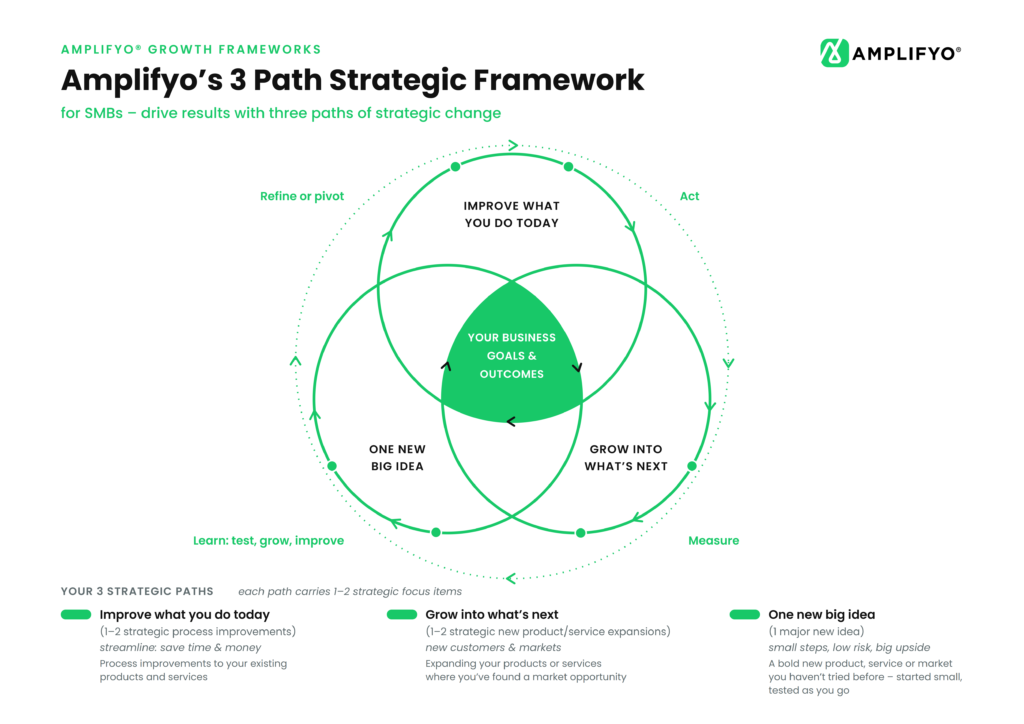
For a small business this is liberating, not threatening. The lag between deciding and doing has collapsed… which is a great competitive edge, especially for active leaders in small and mid-sized businesses. SMBs often have the agility edge over their larger companies / competitors….it’s just a matter of whether you choose to apply action to your Strategic Paths (your major Focus Areas / Strategic Big Rocks) – a glimpse of how we now view strategy.
Struggling with activating strategy? The big companies find it hard too…
The evidence is surprisingly comforting: this isn’t a small or medium sized business problem, it’s a business problem
- Harvard Business Review (Sull et al.) reported that two-thirds to three-quarters of large organisations struggling with strategy execution, and the authors note that writing on strategy outnumbers writing on execution by an order of magnitude. (Source: https://hbr.org/2015/03/why-strategy-execution-unravelsand-what-to-do-about-it)
- McKinsey & Company (2025)shared that in a study of 400+ companies, the biggest gap between winners and stragglers is in mobilisation, translating strategic choices into organisational readiness. Interestingly, the firm that gave us the Three Horizons is now saying the hard part is the handover to action. (Source: https://www.mckinsey.com/capabilities/strategy-and-corporate-finance/our-insights/how-strategy-champions-win)
Paradox Box
The irony with my favorite Steve Blank quote & methodology is that most owners can’t ‘get out of the building’ because they’re stuck inside it doing the marketing. (don’t worry, we’ve built a solution for that)
Why we believe strategy lands more effectively when it’s done with 3-99 people
From our years of working with hundreds of SMBs we believe smaller teams have an edge when it comes to decision-making, because smaller leadership teams enable faster communications & expedited decision-making flows compared to larger organizations.
But it’s also a conscious decisions these leaders need to make, because strategy and then the actions that follow need to evolve, but can be easily stalled. We find the best results when a business actively decides to step away from these common blockers:
- When no one owns the calendar or measures against a timeline,
- content becomes the bottleneck,
- every task is a first-time process that gets reinvented; or
- the owner is the approval layer for everything
…and then no feedback loop or results measurements so nobody knows what worked.
Some of our best results come from working with Partner organizations who bring a localized voice and perspective to strategy and support incredible small businesses to grow. We hear from the partners we work with, things like: my clients don’t need another plan, they need to start the activities that flow on from the strategy we delivered last month! (And they generally tell us that most activity happens when there are just a few decision-makers in the room).
The board-level view: decisive action and the P&L
From a board chair’s perspective (I used to chair the board of a 1000+ person organization), a strategy that isn’t executing is a risk item, not a planning item. And areas like marketing that can’t be traced to the Profit & Loss Statement (P&L) / Income Statement are cost centres asking to be cut. Small businesses don’t often have a board (did I hear a sigh of relief?), but often the same duties fall to the owner and leadership team. They need to carry the decide, act, measure, pivot thinking. And, especially noticeable in smaller businesses, capital efficiency is king, and it’s a credit to leaders who have the discipline of not doing the things the plan says are secondary.
Leadership & Culture
Allow me to bring in one of my favorite speakers on people and culture here too – Simon Sinek. His consistent theme is that leaders are responsible for the environment, and the environment determines whether people can do their best work
=> this applies to small businesses with only a few or even one leader at the top making decisions. Regardless of the number of decisions-makers and your business size, you need a handle on how to run things in the day to day based on a bigger picture line-of-sight to defined goals (and strategy!). https://simonsinek.com/
The keys to executing strategy (surprisingly, it’s not more effort)
It’s not rocket-science, but it does take discipline and buy-in from your leaders.
- goals connected to daily tasks a cascade of sorts that can track against the bigger plans, and team members can see that their daily tasks and bigger activities are bolted into it
- faster decision-making that empowers your team
- content that’s 80% done before a human touches it
- an always line of sight to what’s moved and what hasn’t
…ultimately the key is protecting your leadership and team’s time so it can be channeled into the customer-facing and customer-impact activities (this includes product development and the R&D side too).
Automate what you can. Keep your people for the conversations (the most important things).
Why we built Amplifyo the way we did
As a former business advisor and consultancy / agency owner, I built incredible strategies that sometimes died in a PDF because they didn’t get executed. I went into every engagement talking through the capabilities of the business to execute (heck, we even offered support services to deliver and even hire and train staff if they needed, but the actual pressures of running a business sometimes distracted teams and diverted them away from healthy execution and ultimately growth).
If you’ve seen my personality profile you’d know why I joined with my tech co-founder to build the thing that connects the strategy to the following day after the strategy / change discussions. (and because I’m a consultant at heart, we’ve built a platform that supports partner organizations to support SMBs too).
From our most recent customer review, we’re saving businesses around 90% of the time they had previously spent on the same Strategy ➔ Content ➔ Execution ➔ Analytics ➔ Next Step Ideas
Our software and business is all about reclaiming time & resources so you and your teams can spend them on what is most important – your customers and clients. And since I can never un-know my director duties and responsibilities, corporate governance thinking is embedded in our architecture and is reflected in our responsible AI and data privacy practices.
Wrapping up
The following day is where strategy lives or dies. Not in the workshop, not in the PDF, not in the meeting with your accountant. The day after.
If you run a business, the plan you already have is probably good enough. What it’s missing is an owner, a next step, and a way to see whether it moved anything. Decide that before the inbox wins (the struggle is real!).
If you’re an advisor, mentor or agency supporting smaller businesses, your clients or members aren’t short on direction. They’re short on time / people / resource margin. The most valuable thing you can give them isn’t another document; it’s a way to make the following day happen.
That’s the gap we built Amplifyo to close, for owners and for the partners who support them. If it sounds like your world, our partner program can be found here. And if you’d rather just compare notes on why good strategies stall, that’s a conversation I’m always happy to have; it’s the one I got out of the building for.


